고정 헤더 영역
상세 컨텐츠
본문
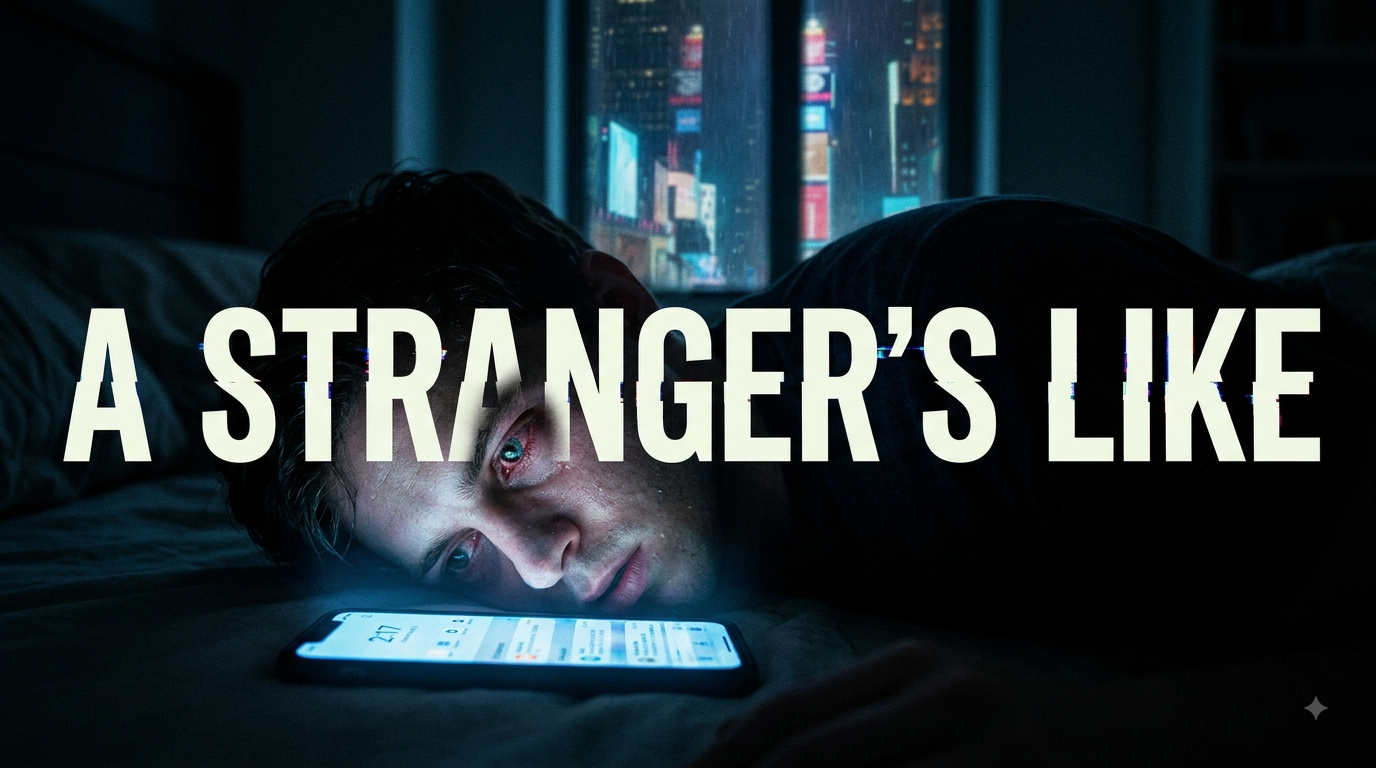
It was 2:17 in the morning. The streets of New York were still lit up, but Ethan Cole's apartment was dark.
Only one thing gave off any light — his phone. Ethan lay flat on his bed, staring at the screen.
He refreshed it. 8 likes. He refreshed again. 8 likes. A third time. Still 8.
"Come on…" He set the phone down on the table. Ten seconds passed, and he picked it up again.
8 likes. Ethan closed his eyes. Yesterday, at this exact time, one of his posts had 31,000 likes.
Today, only 8. To him, this wasn't just a number — it was a question: "Have people forgotten me?"
Three months ago, Ethan wasn't like this. He was a young screenwriter living in New York.
He sat in coffee shops writing scripts, had dinner with friends, watched movies on weekends.
His life wasn't perfect, but it worked. Then something changed.
First, he started going to fewer parties. Then he began replying to friends' messages late.
Then he stopped replying at all. Eventually, even leaving his apartment felt hard.
The alarm would ring in the morning. Ethan would open his eyes, stare at the ceiling, and reach for his phone.
Picking up the phone was easy. Calling a friend, going to someone's house, taking a shower — all of that was hard.
But the phone was always there. He didn't need to get ready for it, didn't need to fake a smile for it.
If a conversation felt bad, he could just lock the screen. And if someone judged him, he could hide behind an anonymous account.
Slowly, Ethan realized social media wasn't his entertainment anymore. It had become his social life.
One night Ethan wrote a post — just one sentence: "Sometimes a person doesn't need people."
"They just need the feeling that someone is noticing them." He posted it and set the phone aside.
Five minutes later he checked: 12 likes. He smiled. Ten minutes later, 47.
An hour later, 312. Then the number climbed fast — 1,100, 4,800, 12,000.
Ethan sat up in bed, tears in his eyes, as the number changed again: 31,000.
Comments poured in below it — "You put my feelings into words," "I thought I was the only one," "Thank you."
Ethan held the phone to his chest and said softly, "I'm not invisible."
That night, for the first time in months, he felt like someone in the world was actually seeing him.
But the most dangerous part of social media wasn't that it sometimes ignores your post.
It's that sometimes it gives you an enormous reward, and then you want to get that reward again.
That's exactly what happened to Ethan. The next morning he posted again, then a second time, then a third.
But nothing special happened — 4 likes, 9 likes, 2 likes. He couldn't understand it.
Yesterday 31,000. Today 2. He deleted the post, made a new one, deleted that too, made another.
He kept refreshing the screen, not even realizing that he wasn't using social media anymore — social media was using him.
Around this time, a research team at Princeton University was noticing something strange too.
Computational neuroscientist Yael Niv and psychology professor Claire Gillan were studying social media behavior.
They analyzed over 7,000 users across three datasets from X, looking at each user's most recent 3,200 posts.
An interesting pattern emerged: some users affected by depression seemed more sensitive to social feedback.
The research didn't mean social media causes depression, but it pointed to a possibility.
Some people use social media to find the social connection that has become hard for them to find in real life.
Ethan seemed like a perfect example of this theory.
One day Ethan picked up his phone and said to himself, "Enough." He deleted the social media app.
He put the phone on the table. Five minutes passed, then ten, then twenty.
He grew restless, picked the phone back up, and started reinstalling the app.
Before it finished installing, his phone rang — an unknown number. He ignored it.
It rang again; he ignored it again. On the third ring, irritated, he picked up.
"Hello?" A girl's voice answered. "Ethan?"
He stayed silent. "It's Sophie." Ethan closed his eyes.
Sophie was an old friend of his. He said nothing for a few seconds. She asked softly, "Are you okay?"
"Yeah," he said automatically. Sophie laughed.
"You still go quiet for three extra seconds when you're lying."
Tears came to his eyes. For the first time, he told someone the truth: "No. I'm not okay."
The next day they met at a coffee shop. Ethan felt awkward, unsure what to say.
Sophie didn't lecture him or offer advice — she just sat across from him, drinking her coffee.
After a while he said, "You know my post got 31,000 likes yesterday?"
She smiled. "Yeah, I saw it." He asked, "At that moment I felt like I mattered."
"And now?" He looked down at his cup. "Now I think it was just a number."
"So what made you feel like you mattered?" she asked. Ethan looked at her.
He didn't have an answer.
That night Ethan reopened his old viral post — 31,000 likes, thousands of comments.
But this time he noticed something else: most of those people didn't even know him.
They'd liked his sentence, glanced at his profile picture, tapped the like button, and gone back to their own lives.
For the first time, he understood: 31,000 likes doesn't mean 31,000 relationships.
And 8 likes doesn't mean nobody likes you either. The numbers were just numbers.
His mind was the one giving them meaning.
A few days later Ethan attended a public event at Princeton, where Yael Niv was speaking about social media and human behavior.
He sat quietly in the audience as she said, "In real life, social feedback is complicated."
"You can't measure the exact meaning of someone's smile. But social media gives you a number."
"10 likes. 100 likes. 10,000 likes." She looked out at the crowd.
"But if you got 10 likes today and 8 tomorrow… are you really 20 percent less valuable?"
There was light laughter in the audience. Ethan didn't laugh — it felt like the question was aimed straight at him.
Niv added, "Numbers feel meaningful. But they're not necessarily as meaningful as we think they are."
Ethan put his phone in his pocket. This time, he didn't look at the screen.
A few months later, Ethan's life wasn't perfect. He still felt lonely sometimes.
He still checked social media, still felt a small thrill seeing likes on a post.
The only difference was that now he didn't let a number become his identity.
One evening Sophie asked, "Why don't you just quit social media completely?"
"Because it isn't the enemy," Ethan said. "Then what is?"
He thought for a moment. "Maybe... it's when I start asking it to give me something it can't give me."
"What?" He looked out the window. "Proof that I'm worth something."
That night Ethan wrote one last post — not to go viral this time.
It simply said: "I didn't get a single like today. And surprisingly, I'm okay."
He published it, put the phone down on the table, and walked out of the bedroom.
A little while later, a notification appeared. 1 like. Then another — 2.
Then a third — 3. Ethan came back into the room, looked at the screen, and smiled.
Then he turned the phone off.
For the first time, he understood that sometimes the most important like is the one the world doesn't give you.
It's the one you give yourself.
And that night, Ethan didn't choose his screen.
He chose his life.


